Sim_LAMMPS_EDIP_LucasBertolusPizzagalli_2009_SiC__SM_435704953434_000
| Title
A single sentence description.
|
LAMMPS EDIP potential for Si-C developed by Lucas, Bertolus, and Pizzagalli (2009) v000 |
|---|---|
| Description |
An interatomic potential has been developed to describe interactions in silicon, carbon, and silicon carbide. This model generalizes the semi-empirical interatomic potential EDIP, initially designed for silicon (Bazant et al. 1997 Phys. Rev. B 56 8542), for modeling silicon carbide. In addition, the functional form of the original EDIP has been generalized, where all the parameters for Si–Si, C–C, and Si–C interactions are new. This potential has been tested for silicon, carbon (diamond), and silicon carbide for a wide range of properties, including bulk properties stability and structure of high-pressure crystalline phases, formation energy and point structure, extended defects, and amorphous phases structure. The proposed potential enables an accurate description of point and extended defects in silicon, diamond, and silicon carbide, thus preserving the initial focus of the original EDIP potential. An extra feature of this parameter set is the excellent description of the high-pressure phases of the different materials. NOTE: This model was previously named Sim_LAMMPS_EDIP_JiangMorganSzlufarska_2012_SiC__SM_435704953434_000. It was discovered that the header in the parameter file contained in the model was erroneous and that, in fact, the parameters are from G. Lucas, M. Bertolus, and L. Pizzagalli, J. Phys.: Condens. Matter 22, 035802 (2009). |
| Species
The supported atomic species.
| C, Si |
| Disclaimer
A statement of applicability provided by the contributor, informing users of the intended use of this KIM Item.
|
None |
| Content Origin | LAMMPS package 30-Jul-2021 |
| Contributor |
Daniel S. Karls |
| Maintainer |
Daniel S. Karls |
| Implementer | Chao Jiang |
| Developer |
G. Lucas M. Bertolus L. Pizzagalli |
| Published on KIM | 2019 |
| How to Cite |
This Simulator Model originally published in [1] is archived in OpenKIM [2-4]. [1] Lucas G, Bertolus M, Pizzagalli L. An environment-dependent interatomic potential for silicon carbide: calculation of bulk properties, high-pressure phases, point and extended defects, and amorphous structures. Journal of Physics: Condensed Matter. 2009Dec;22(3):035802. doi:10.1088/0953-8984/22/3/035802 — (Primary Source) A primary source is a reference directly related to the item documenting its development, as opposed to other sources that are provided as background information. [2] Jiang C, Lucas G, Bertolus M, Pizzagalli L. LAMMPS EDIP potential for Si-C developed by Lucas, Bertolus, and Pizzagalli (2009) v000. OpenKIM; 2019. doi:10.25950/b67a8c85 [3] Tadmor EB, Elliott RS, Sethna JP, Miller RE, Becker CA. The potential of atomistic simulations and the Knowledgebase of Interatomic Models. JOM. 2011;63(7):17. doi:10.1007/s11837-011-0102-6 [4] Elliott RS, Tadmor EB. Knowledgebase of Interatomic Models (KIM) Application Programming Interface (API). OpenKIM; 2011. doi:10.25950/ff8f563a Click here to download the above citation in BibTeX format. |
| Citations
This panel presents information regarding the papers that have cited the interatomic potential (IP) whose page you are on. The OpenKIM machine learning based Deep Citation framework is used to determine whether the citing article actually used the IP in computations (denoted by "USED") or only provides it as a background citation (denoted by "NOT USED"). For more details on Deep Citation and how to work with this panel, click the documentation link at the top of the panel. The word cloud to the right is generated from the abstracts of IP principle source(s) (given below in "How to Cite") and the citing articles that were determined to have used the IP in order to provide users with a quick sense of the types of physical phenomena to which this IP is applied. The bar chart shows the number of articles that cited the IP per year. Each bar is divided into green (articles that USED the IP) and blue (articles that did NOT USE the IP). Users are encouraged to correct Deep Citation errors in determination by clicking the speech icon next to a citing article and providing updated information. This will be integrated into the next Deep Citation learning cycle, which occurs on a regular basis. OpenKIM acknowledges the support of the Allen Institute for AI through the Semantic Scholar project for providing citation information and full text of articles when available, which are used to train the Deep Citation ML algorithm. |
This panel provides information on past usage of this interatomic potential (IP) powered by the OpenKIM Deep Citation framework. The word cloud indicates typical applications of the potential. The bar chart shows citations per year of this IP (bars are divided into articles that used the IP (green) and those that did not (blue)). The complete list of articles that cited this IP is provided below along with the Deep Citation determination on usage. See the Deep Citation documentation for more information. 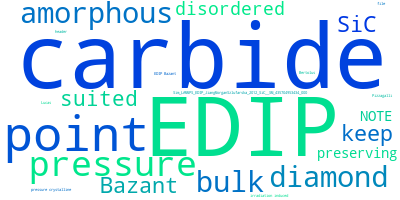
38 Citations (24 used)
Help us to determine which of the papers that cite this potential actually used it to perform calculations. If you know, click the .
USED (high confidence) Y. Xie, J. Vandermause, S. Ramakers, N. Protik, A. Johansson, and B. Kozinsky, “Uncertainty-aware molecular dynamics from Bayesian active learning for phase transformations and thermal transport in SiC,” npj Computational Materials. 2022. link Times cited: 14 USED (high confidence) E. M. Y. Lee, A. Yu, J. D. de Pablo, and G. Galli, “Stability and molecular pathways to the formation of spin defects in silicon carbide,” Nature Communications. 2021. link Times cited: 9 USED (high confidence) D. Kilymis, C. Gérard, and L. Pizzagalli, “Ductile deformation of core-shell Si-SiC nanoparticles controlled by shell thickness,” Acta Materialia. 2019. link Times cited: 12 USED (high confidence) B. Szpunar, L. Malakkal, J. Rahman, and J. Szpunar, “Atomistic modeling of thermo‐mechanical properties of cubic SiC,” Journal of the American Ceramic Society. 2018. link Times cited: 10 USED (low confidence) J. Lim et al., “Molecular Dynamics Study of Silicon Carbide Using an Ab Initio-Based Neural Network Potential: Effect of Composition and Temperature on Crystallization Behavior,” The Journal of Physical Chemistry C. 2023. link Times cited: 0 USED (low confidence) N. Mitra and K. Ramesh, “Physics of molecular deformation mechanism in 6H-SiC,” Modelling and Simulation in Materials Science and Engineering. 2023. link Times cited: 2 Abstract: Even though there have been several studies in literature of… read more USED (low confidence) K. W. Kayang and A. Volkov, “Effect of the shell thickness on the mechanical properties of arrays composed of hybrid core-shell Si/SiC nanoparticles with overlapped shells,” Ceramics International. 2022. link Times cited: 1 USED (low confidence) L. Xue, G. Feng, B. Gao, and S. Liu, “Effect of groove-textured 4H-SiC on the deformation behavior of deposited film using molecular dynamics,” Applied Physics A. 2022. link Times cited: 0 USED (low confidence) X.-W. Chen and R. Huang, “Morphological Transition of Vicinal 4H-SiC Surface Observed during Repeated Annealing,” ACS Applied Nano Materials. 2022. link Times cited: 0 USED (low confidence) S. Stelmakh, K. Skrobas, K. Stefanska-Skrobas, S. Gierlotka, and B. Palosz, “Distortion of SiC lattice induced by carbon-coating on (100) and (111) surfaces - ab-initio and molecular dynamics study,” Surface Science. 2022. link Times cited: 1 USED (low confidence) V. Kushch, “A Study of Thermodynamic and Elastic Properties of Nanosized Diamond Single Crystals by the Classical Molecular Dynamics Method,” Journal of Superhard Materials. 2022. link Times cited: 2 USED (low confidence) L. Xue, G. Feng, and S. Liu, “Molecular dynamics study of temperature effect on deformation behavior of m-plane 4H–SiC film by nanoindentation,” Vacuum. 2022. link Times cited: 5 USED (low confidence) Q. Ran et al., “Molecular dynamics simulation of displacement cascades in cubic silicon carbide,” Nuclear materials and energy. 2021. link Times cited: 10 USED (low confidence) B. Yang, H. Yang, T. Li, J. Yang, and P. Yang, “Thermal transport at 6H-SiC/graphene buffer layer/GaN heterogeneous interface,” Applied Surface Science. 2021. link Times cited: 16 USED (low confidence) J. Luo, C. Zhou, Y. Cheng, and L. Liu, “Assessing the EDIP potential for atomic simulation of carbon diffusion, segregation and solubility in silicon melt,” Journal of Crystal Growth. 2020. link Times cited: 2 USED (low confidence) Z. Wu, W. Liu, and L. Zhang, “Effect of structural anisotropy on the dislocation nucleation and evolution in 6H SiC under nanoindentation,” Ceramics International. 2019. link Times cited: 23 USED (low confidence) Z. Wu, W. Liu, L. Zhang, and S. Lim, “Amorphization and Dislocation Evolution Mechanisms of Single Crystalline 6H-SiC,” Materials Engineering eJournal. 2019. link Times cited: 67 Abstract: The amorphization and dislocation evolution mechanisms of a … read more USED (low confidence) A. Kubo, S. Nagao, and Y. Umeno, “Molecular dynamics study of deformation and fracture in SiC with angular dependent potential model,” Computational Materials Science. 2017. link Times cited: 7 USED (low confidence) S. Goel, S. Chavoshi, and A. Murphy, “Molecular dynamics simulation (MDS) to study nanoscale machining processes.” 2017. link Times cited: 2 Abstract: 1 Molecular dynamics simulation (MDS) to study nanoscale cut… read more USED (low confidence) J. Han, M. Park, A. Lee, D. Sohn, J. Park, and S. Im, “Temperature dependence of screw dislocation mobility on shuffle-set of silicon,” Metals and Materials International. 2014. link Times cited: 1 USED (low confidence) J. Rabier and L. Pizzagalli, “Dislocation dipole annihilation in diamond and silicon,” Journal of Physics: Conference Series. 2011. link Times cited: 5 Abstract: The mechanism of dislocation dipole annihilation has been in… read more USED (low confidence) L. Xue et al., “Study of deformation mechanism of structural anisotropy in 4H–SiC film by nanoindentation,” Materials Science in Semiconductor Processing. 2022. link Times cited: 5 USED (low confidence) S. Goel, X. Luo, A. Agrawal, and R. Reuben, “Diamond machining of silicon: A review of advances in molecular dynamics simulation,” International Journal of Machine Tools & Manufacture. 2015. link Times cited: 314 USED (low confidence) V. Venkatesh, “Computer simulation studies of carbon nanotube and its interactions with water.” 2014. link Times cited: 1 Abstract: ii addition to defect concentration, the location of defects… read more NOT USED (low confidence) K. W. Kayang and A. N. Volkov, “Turning nanopowder into nanomaterial: Effect of continuous SiC coating on mechanical properties of Si nanoparticle arrays,” Materialia. 2023. link Times cited: 0 NOT USED (low confidence) Y. Lysogorskiy, T. Hammerschmidt, J. Janssen, J. Neugebauer, and R. Drautz, “Transferability of interatomic potentials for molybdenum and silicon,” Modelling and Simulation in Materials Science and Engineering. 2019. link Times cited: 14 Abstract: Interatomic potentials are widely used in computational mate… read more NOT USED (low confidence) P. Maya, U. Toussaint, and W. Jacob, “What makes a dangling bond a binding site for thermal CH3 radicals? — A combined molecular dynamics and potential energy analysis study on amorphous hydrocarbon films,” Diamond and Related Materials. 2013. link Times cited: 5 NOT USED (high confidence) F. Elahi, Z. Zhang, and Z. Hossain, “Toughness and strength anisotropy among high-symmetry directions in 3C-SiC,” Journal of Applied Physics. 2020. link Times cited: 8 Abstract: This paper presents a quantitative understanding of toughnes… read more NOT USED (high confidence) L. Pizzagalli, “Atomistic modeling of point defect contributions to swelling in Xe-implanted silicon carbide,” Journal of Nuclear Materials. 2018. link Times cited: 6 NOT USED (high confidence) R. Peterson and D. Senesky, “Modeling of radiation-induced defect recovery in 3C-SiC under high field bias conditions,” Computational Materials Science. 2018. link Times cited: 2 Abstract: In this work, the implications of high field bias conditions… read more NOT USED (high confidence) A. Kaczmarowski, S. Yang, I. Szlufarska, and D. Morgan, “Genetic algorithm optimization of defect clusters in crystalline materials,” Computational Materials Science. 2015. link Times cited: 24 NOT USED (high confidence) T. Ito, T. Akiyama, and K. Nakamura, “Empirical interatomic potential approach to the stability of graphitic structure in ANB8−N compounds,” Japanese Journal of Applied Physics. 2014. link Times cited: 2 Abstract: Empirical bond order potential (BOP) with the aid of ab init… read more NOT USED (high confidence) H. Tetlow, J. Boer, I. Ford, D. Vvedensky, J. Coraux, and L. Kantorovich, “Growth of Epitaxial Graphene: Theory and Experiment,” arXiv: Materials Science. 2014. link Times cited: 222 NOT USED (high confidence) H. Jiang, C. Jiang, D. Morgan, and I. Szlufarska, “Accelerated atomistic simulation study on the stability and mobility of carbon tri-interstitial cluster in cubic SiC,” arXiv: Materials Science. 2014. link Times cited: 19 NOT USED (high confidence) F. Zirkelbach, B. Stritzker, K. Nordlund, J. Lindner, W. Schmidt, and E. Rauls, “Combined ab initio and classical potential simulation study on silicon carbide precipitation in silicon,” Physical Review B. 2011. link Times cited: 22 Abstract: Atomistic simulations on the silicon carbide precipitation i… read more NOT USED (high confidence) F. Zirkelbach, B. Stritzker, K. Nordlund, J. Lindner, W. Schmidt, and E. Rauls, “Defects in carbon implanted silicon calculated by classical potentials and first-principles methods,” Physical Review B. 2010. link Times cited: 7 Abstract: A comparative theoretical investigation of carbon interstiti… read more NOT USED (high confidence) E. Lampin, C. Priester, C. Krzeminski, and L. Magaud, “Graphene buffer layer on Si-terminated SiC studied with an empirical interatomic potential,” Journal of Applied Physics. 2010. link Times cited: 23 Abstract: The atomistic structure of the graphenebuffer layer on Si-te… read more NOT USED (high confidence) C. Jiang, D. Morgan, and I. Szlufarska, “Structures and stabilities of small carbon interstitial clusters in cubic silicon carbide,” Acta Materialia. 2014. link Times cited: 19 |
| Funding | Not available |
| Short KIM ID
The unique KIM identifier code.
| SM_435704953434_000 |
| Extended KIM ID
The long form of the KIM ID including a human readable prefix (100 characters max), two underscores, and the Short KIM ID. Extended KIM IDs can only contain alpha-numeric characters (letters and digits) and underscores and must begin with a letter.
| Sim_LAMMPS_EDIP_LucasBertolusPizzagalli_2009_SiC__SM_435704953434_000 |
| DOI |
10.25950/b67a8c85 https://doi.org/10.25950/b67a8c85 https://commons.datacite.org/doi.org/10.25950/b67a8c85 |
| KIM Item Type | Simulator Model |
| KIM API Version | 2.1 |
| Simulator Name
The name of the simulator as defined in kimspec.edn.
| LAMMPS |
| Potential Type | edip |
| Simulator Potential | edip |
| Run Compatibility | portable-models |
| Grade | Name | Category | Brief Description | Full Results | Aux File(s) |
|---|---|---|---|---|---|
| P | vc-species-supported-as-stated | mandatory | The model supports all species it claims to support; see full description. |
Results | Files |
| P | vc-periodicity-support | mandatory | Periodic boundary conditions are handled correctly; see full description. |
Results | Files |
| P | vc-permutation-symmetry | mandatory | Total energy and forces are unchanged when swapping atoms of the same species; see full description. |
Results | Files |
| A | vc-forces-numerical-derivative | consistency | Forces computed by the model agree with numerical derivatives of the energy; see full description. |
Results | Files |
| P | vc-dimer-continuity-c1 | informational | The energy versus separation relation of a pair of atoms is C1 continuous (i.e. the function and its first derivative are continuous); see full description. |
Results | Files |
| P | vc-objectivity | informational | Total energy is unchanged and forces transform correctly under rigid-body translation and rotation; see full description. |
Results | Files |
| P | vc-inversion-symmetry | informational | Total energy is unchanged and forces change sign when inverting a configuration through the origin; see full description. |
Results | Files |
| F | vc-memory-leak | informational | The model code does not have memory leaks (i.e. it releases all allocated memory at the end); see full description. |
Results | Files |
| N/A | vc-thread-safe | mandatory | The model returns the same energy and forces when computed in serial and when using parallel threads for a set of configurations. Note that this is not a guarantee of thread safety; see full description. |
Results | Files |
BCC Lattice Constant
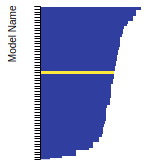
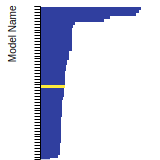
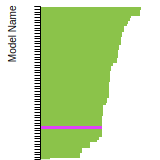
This bar chart plot shows the mono-atomic body-centered cubic (bcc) lattice constant predicted by the current model (shown in the unique color) compared with the predictions for all other models in the OpenKIM Repository that support the species. The vertical bars show the average and standard deviation (one sigma) bounds for all model predictions. Graphs are generated for each species supported by the model.
Cohesive Energy Graph
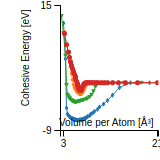
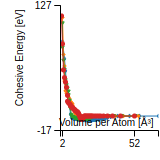
This graph shows the cohesive energy versus volume-per-atom for the current mode for four mono-atomic cubic phases (body-centered cubic (bcc), face-centered cubic (fcc), simple cubic (sc), and diamond). The curve with the lowest minimum is the ground state of the crystal if stable. (The crystal structure is enforced in these calculations, so the phase may not be stable.) Graphs are generated for each species supported by the model.
Diamond Lattice Constant
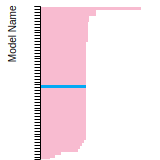
This bar chart plot shows the mono-atomic face-centered diamond lattice constant predicted by the current model (shown in the unique color) compared with the predictions for all other models in the OpenKIM Repository that support the species. The vertical bars show the average and standard deviation (one sigma) bounds for all model predictions. Graphs are generated for each species supported by the model.
Dislocation Core Energies
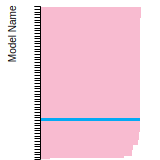
This graph shows the dislocation core energy of a cubic crystal at zero temperature and pressure for a specific set of dislocation core cutoff radii. After obtaining the total energy of the system from conjugate gradient minimizations, non-singular, isotropic and anisotropic elasticity are applied to obtain the dislocation core energy for each of these supercells with different dipole distances. Graphs are generated for each species supported by the model.
(No matching species)FCC Elastic Constants
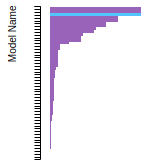
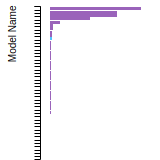
This bar chart plot shows the mono-atomic face-centered cubic (fcc) elastic constants predicted by the current model (shown in blue) compared with the predictions for all other models in the OpenKIM Repository that support the species. The vertical bars show the average and standard deviation (one sigma) bounds for all model predictions. Graphs are generated for each species supported by the model.
FCC Lattice Constant
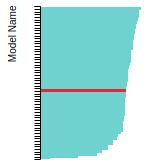
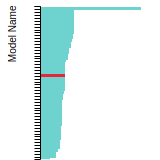
This bar chart plot shows the mono-atomic face-centered cubic (fcc) lattice constant predicted by the current model (shown in red) compared with the predictions for all other models in the OpenKIM Repository that support the species. The vertical bars show the average and standard deviation (one sigma) bounds for all model predictions. Graphs are generated for each species supported by the model.
FCC Stacking Fault Energies
This bar chart plot shows the intrinsic and extrinsic stacking fault energies as well as the unstable stacking and unstable twinning energies for face-centered cubic (fcc) predicted by the current model (shown in blue) compared with the predictions for all other models in the OpenKIM Repository that support the species. The vertical bars show the average and standard deviation (one sigma) bounds for all model predictions. Graphs are generated for each species supported by the model.
(No matching species)FCC Surface Energies
This bar chart plot shows the mono-atomic face-centered cubic (fcc) relaxed surface energies predicted by the current model (shown in blue) compared with the predictions for all other models in the OpenKIM Repository that support the species. The vertical bars show the average and standard deviation (one sigma) bounds for all model predictions. Graphs are generated for each species supported by the model.
(No matching species)SC Lattice Constant
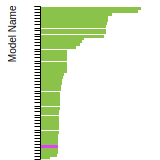
This bar chart plot shows the mono-atomic simple cubic (sc) lattice constant predicted by the current model (shown in the unique color) compared with the predictions for all other models in the OpenKIM Repository that support the species. The vertical bars show the average and standard deviation (one sigma) bounds for all model predictions. Graphs are generated for each species supported by the model.
Cubic Crystal Basic Properties Table
Species: CSpecies: Si
Creators: Daniel S. Karls
Contributor: karls
Publication Year: 2019
DOI: https://doi.org/10.25950/b47dd4c4
Given an xyz file corresponding to a finite cluster of atoms, this Test Driver computes the total potential energy and atomic forces on the configuration. The positions are then relaxed using conjugate gradient minimization and the final positions and forces are recorded. These results are primarily of interest for training machine-learning algorithms.
Creators: Daniel S. Karls
Contributor: karls
Publication Year: 2018
DOI: https://doi.org/10.25950/c6746c52
This Test Driver uses LAMMPS to compute the cohesive energy of a given monoatomic cubic lattice (fcc, bcc, sc, or diamond) at a variety of lattice spacings. The lattice spacings range from a_min (=a_min_frac*a_0) to a_max (=a_max_frac*a_0) where a_0, a_min_frac, and a_max_frac are read from stdin (a_0 is typically approximately equal to the equilibrium lattice constant). The precise scaling and number of lattice spacings sampled between a_min and a_0 (a_0 and a_max) is specified by two additional parameters passed from stdin: N_lower and samplespacing_lower (N_upper and samplespacing_upper). Please see README.txt for further details.
| Test | Test Results | Link to Test Results page | Benchmark time
Usertime multiplied by the Whetstone Benchmark. This number can be used (approximately) to compare the performance of different models independently of the architecture on which the test was run.
Measured in Millions of Whetstone Instructions (MWI) |
|---|---|---|---|
| Cohesive energy versus lattice constant curve for bcc Carbon | view | 3273 | |
| Cohesive energy versus lattice constant curve for diamond Carbon | view | 2952 | |
| Cohesive energy versus lattice constant curve for fcc Carbon | view | 2952 | |
| Cohesive energy versus lattice constant curve for sc Carbon | view | 3176 |
Creators:
Contributor: karls
Publication Year: 2019
DOI: https://doi.org/10.25950/64cb38c5
This Test Driver uses LAMMPS to compute the cohesive energy of a given monoatomic cubic lattice (fcc, bcc, sc, or diamond) at a variety of lattice spacings. The lattice spacings range from a_min (=a_min_frac*a_0) to a_max (=a_max_frac*a_0) where a_0, a_min_frac, and a_max_frac are read from stdin (a_0 is typically approximately equal to the equilibrium lattice constant). The precise scaling and number of lattice spacings sampled between a_min and a_0 (a_0 and a_max) is specified by two additional parameters passed from stdin: N_lower and samplespacing_lower (N_upper and samplespacing_upper). Please see README.txt for further details.
| Test | Test Results | Link to Test Results page | Benchmark time
Usertime multiplied by the Whetstone Benchmark. This number can be used (approximately) to compare the performance of different models independently of the architecture on which the test was run.
Measured in Millions of Whetstone Instructions (MWI) |
|---|---|---|---|
| Cohesive energy versus lattice constant curve for bcc Si v004 | view | 1790 | |
| Cohesive energy versus lattice constant curve for diamond Si v004 | view | 1691 | |
| Cohesive energy versus lattice constant curve for fcc Si v004 | view | 1914 | |
| Cohesive energy versus lattice constant curve for sc Si v004 | view | 1914 |
Creators:
Contributor: ilia
Publication Year: 2024
DOI: https://doi.org/10.25950/888f9943
Computes the elastic constants for an arbitrary crystal. A robust computational protocol is used, attempting multiple methods and step sizes to achieve an acceptably low error in numerical differentiation and deviation from material symmetry. The crystal structure is specified using the AFLOW prototype designation as part of the Crystal Genome testing framework. In addition, the distance from the obtained elasticity tensor to the nearest isotropic tensor is computed.
| Test | Test Results | Link to Test Results page | Benchmark time
Usertime multiplied by the Whetstone Benchmark. This number can be used (approximately) to compare the performance of different models independently of the architecture on which the test was run.
Measured in Millions of Whetstone Instructions (MWI) |
|---|---|---|---|
| Elastic constants for CSi in AFLOW crystal prototype A2B_cP12_205_c_a at zero temperature and pressure v000 | view | 177115 |
Creators: Junhao Li and Ellad Tadmor
Contributor: tadmor
Publication Year: 2019
DOI: https://doi.org/10.25950/49c5c255
Computes the cubic elastic constants for some common crystal types (fcc, bcc, sc, diamond) by calculating the hessian of the energy density with respect to strain. An estimate of the error associated with the numerical differentiation performed is reported.
| Test | Test Results | Link to Test Results page | Benchmark time
Usertime multiplied by the Whetstone Benchmark. This number can be used (approximately) to compare the performance of different models independently of the architecture on which the test was run.
Measured in Millions of Whetstone Instructions (MWI) |
|---|---|---|---|
| Elastic constants for bcc C at zero temperature v005 | view | 4684 | |
| Elastic constants for diamond C at zero temperature v000 | view | 20759 | |
| Elastic constants for fcc C at zero temperature v005 | view | 4684 | |
| Elastic constants for sc C at zero temperature v005 | view | 3946 |
Creators: Junhao Li and Ellad Tadmor
Contributor: tadmor
Publication Year: 2019
DOI: https://doi.org/10.25950/5853fb8f
Computes the cubic elastic constants for some common crystal types (fcc, bcc, sc, diamond) by calculating the hessian of the energy density with respect to strain. An estimate of the error associated with the numerical differentiation performed is reported.
| Test | Test Results | Link to Test Results page | Benchmark time
Usertime multiplied by the Whetstone Benchmark. This number can be used (approximately) to compare the performance of different models independently of the architecture on which the test was run.
Measured in Millions of Whetstone Instructions (MWI) |
|---|---|---|---|
| Elastic constants for bcc Si at zero temperature v006 | view | 2335 | |
| Elastic constants for diamond Si at zero temperature v001 | view | 10204 | |
| Elastic constants for fcc Si at zero temperature v006 | view | 2047 | |
| Elastic constants for sc Si at zero temperature v006 | view | 2335 |
Creators: Junhao Li
Contributor: jl2922
Publication Year: 2018
DOI: https://doi.org/10.25950/2e4b93d9
Computes the elastic constants for hcp crystals by calculating the hessian of the energy density with respect to strain. An estimate of the error associated with the numerical differentiation performed is reported.
| Test | Test Results | Link to Test Results page | Benchmark time
Usertime multiplied by the Whetstone Benchmark. This number can be used (approximately) to compare the performance of different models independently of the architecture on which the test was run.
Measured in Millions of Whetstone Instructions (MWI) |
|---|---|---|---|
| Elastic constants for hcp C at zero temperature | view | 3112 | |
| Elastic constants for hcp Si at zero temperature | view | 3433 |
Creators:
Contributor: ilia
Publication Year: 2024
DOI: https://doi.org/10.25950/2f2c4ad3
Computes the equilibrium crystal structure and energy for an arbitrary crystal at zero temperature and applied stress by performing symmetry-constrained relaxation. The crystal structure is specified using the AFLOW prototype designation. Multiple sets of free parameters corresponding to the crystal prototype may be specified as initial guesses for structure optimization. No guarantee is made regarding the stability of computed equilibria, nor that any are the ground state.
Creators: Ilia Nikiforov
Contributor: ilia
Publication Year: 2019
DOI: https://doi.org/10.25950/dd36239b
Given atomic species and structure type (graphene-like, 2H, or 1T) of a 2D hexagonal monolayer crystal, as well as an initial guess at the lattice spacing, this Test Driver calculates the equilibrium lattice spacing and cohesive energy using Polak-Ribiere conjugate gradient minimization in LAMMPS
| Test | Test Results | Link to Test Results page | Benchmark time
Usertime multiplied by the Whetstone Benchmark. This number can be used (approximately) to compare the performance of different models independently of the architecture on which the test was run.
Measured in Millions of Whetstone Instructions (MWI) |
|---|---|---|---|
| Cohesive energy and equilibrium lattice constant of graphene v002 | view | 2303 |
Creators: Daniel S. Karls and Junhao Li
Contributor: karls
Publication Year: 2019
DOI: https://doi.org/10.25950/2765e3bf
Equilibrium lattice constant and cohesive energy of a cubic lattice at zero temperature and pressure.
| Test | Test Results | Link to Test Results page | Benchmark time
Usertime multiplied by the Whetstone Benchmark. This number can be used (approximately) to compare the performance of different models independently of the architecture on which the test was run.
Measured in Millions of Whetstone Instructions (MWI) |
|---|---|---|---|
| Equilibrium zero-temperature lattice constant for bcc C v007 | view | 6942 | |
| Equilibrium zero-temperature lattice constant for bcc Si v007 | view | 5470 | |
| Equilibrium zero-temperature lattice constant for diamond C v007 | view | 6078 | |
| Equilibrium zero-temperature lattice constant for diamond Si v007 | view | 7709 | |
| Equilibrium zero-temperature lattice constant for fcc C v007 | view | 6622 | |
| Equilibrium zero-temperature lattice constant for fcc Si v007 | view | 6078 | |
| Equilibrium zero-temperature lattice constant for sc C v007 | view | 7166 | |
| Equilibrium zero-temperature lattice constant for sc Si v007 | view | 5918 |
Creators: Junhao Li
Contributor: jl2922
Publication Year: 2018
DOI: https://doi.org/10.25950/25bcc28b
Calculates lattice constant of hexagonal bulk structures at zero temperature and pressure by using simplex minimization to minimize the potential energy.
| Test | Test Results | Link to Test Results page | Benchmark time
Usertime multiplied by the Whetstone Benchmark. This number can be used (approximately) to compare the performance of different models independently of the architecture on which the test was run.
Measured in Millions of Whetstone Instructions (MWI) |
|---|---|---|---|
| Equilibrium lattice constants for hcp C | view | 11551 | |
| Equilibrium lattice constants for hcp Si | view | 10748 |
Creators:
Contributor: mjwen
Publication Year: 2024
DOI: https://doi.org/10.25950/9d9822ec
This Test Driver uses LAMMPS to compute the linear thermal expansion coefficient at a finite temperature under a given pressure for a cubic lattice (fcc, bcc, sc, diamond) of a single given species.
| Test | Test Results | Link to Test Results page | Benchmark time
Usertime multiplied by the Whetstone Benchmark. This number can be used (approximately) to compare the performance of different models independently of the architecture on which the test was run.
Measured in Millions of Whetstone Instructions (MWI) |
|---|---|---|---|
| Linear thermal expansion coefficient of diamond Si at 293.15 K under a pressure of 0 MPa v002 | view | 838758 |
Creators: Daniel S. Karls
Contributor: karls
Publication Year: 2019
DOI: https://doi.org/10.25950/c3dca28e
Given an extended xyz file corresponding to a non-orthogonal periodic box of atoms, use LAMMPS to compute the total potential energy and atomic forces.
Creators:
Contributor: efuem
Publication Year: 2023
DOI: https://doi.org/10.25950/fca89cea
Computes the monovacancy formation energy and relaxation volume for cubic and hcp monoatomic crystals.
| Test | Test Results | Link to Test Results page | Benchmark time
Usertime multiplied by the Whetstone Benchmark. This number can be used (approximately) to compare the performance of different models independently of the architecture on which the test was run.
Measured in Millions of Whetstone Instructions (MWI) |
|---|---|---|---|
| Monovacancy formation energy and relaxation volume for diamond Si | view | 1319500 |
Creators:
Contributor: efuem
Publication Year: 2023
DOI: https://doi.org/10.25950/c27ba3cd
Computes the monovacancy formation and migration energies for cubic and hcp monoatomic crystals.
| Test | Test Results | Link to Test Results page | Benchmark time
Usertime multiplied by the Whetstone Benchmark. This number can be used (approximately) to compare the performance of different models independently of the architecture on which the test was run.
Measured in Millions of Whetstone Instructions (MWI) |
|---|---|---|---|
| Vacancy formation and migration energy for diamond Si | view | 4668276 |
| Test | Error Categories | Link to Error page |
|---|---|---|
| Elastic constants for hcp C at zero temperature | other | view |
| Elastic constants for hcp Si at zero temperature | other | view |
EquilibriumCrystalStructure__TD_457028483760_000
EquilibriumCrystalStructure__TD_457028483760_002
| Test | Error Categories | Link to Error page |
|---|---|---|
| Equilibrium crystal structure and energy for C in AFLOW crystal prototype A_oC8_67_m v002 | other | view |
LatticeConstantCubicEnergy__TD_475411767977_007
| Test | Error Categories | Link to Error page |
|---|---|---|
| Equilibrium zero-temperature lattice constant for bcc C v007 | other | view |
| Equilibrium zero-temperature lattice constant for diamond C v007 | other | view |
| Equilibrium zero-temperature lattice constant for fcc C v007 | other | view |
| Equilibrium zero-temperature lattice constant for sc C v007 | other | view |
LatticeConstantHexagonalEnergy__TD_942334626465_005
| Test | Error Categories | Link to Error page |
|---|---|---|
| Equilibrium lattice constants for hcp C v005 | other | view |
| Equilibrium lattice constants for hcp Si v005 | other | view |
LinearThermalExpansionCoeffCubic__TD_522633393614_001
| Test | Error Categories | Link to Error page |
|---|---|---|
| Linear thermal expansion coefficient of diamond Si at 293.15 K under a pressure of 0 MPa v001 | other | view |
| Sim_LAMMPS_EDIP_LucasBertolusPizzagalli_2009_SiC__SM_435704953434_000.txz | Tar+XZ | Linux and OS X archive |
| Sim_LAMMPS_EDIP_LucasBertolusPizzagalli_2009_SiC__SM_435704953434_000.zip | Zip | Windows archive |